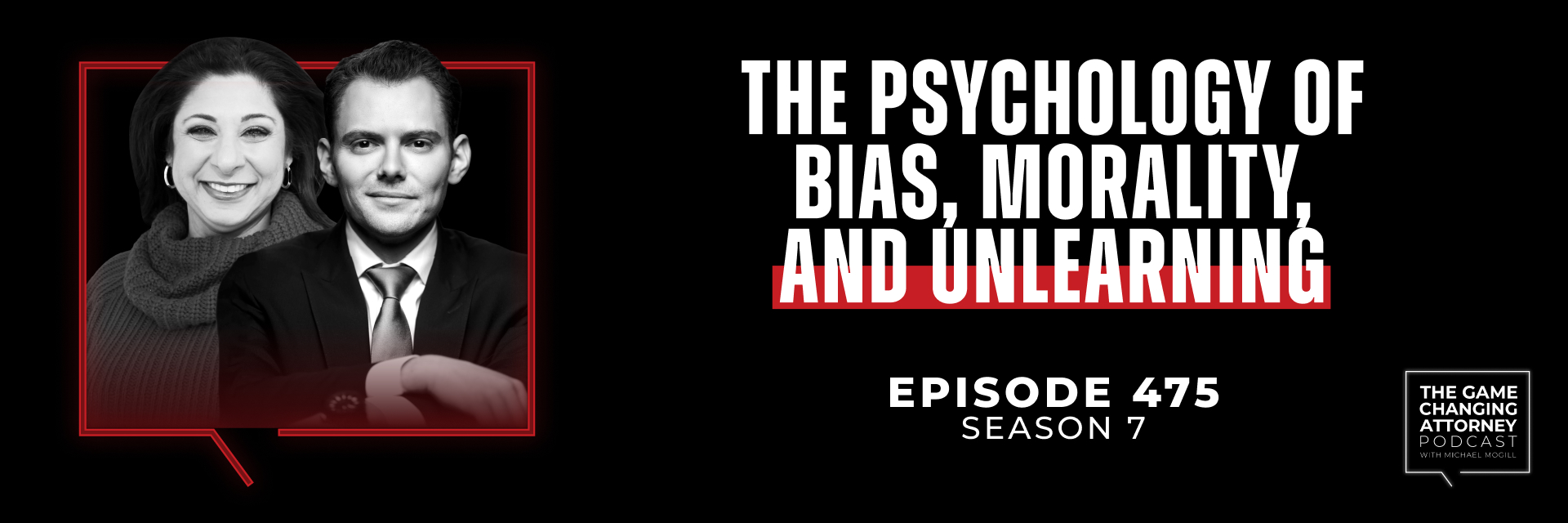
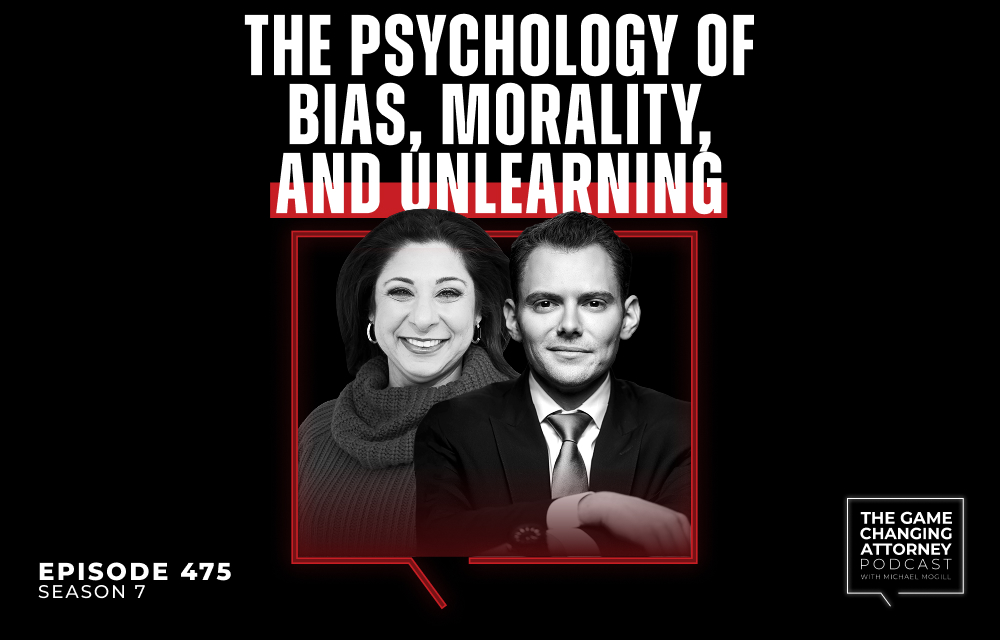
Episode 475 — The Psychology of Bias, Morality, and Unlearning with Dr. Dolly Chugh
What if loving something (your country, your work, your own self-image) actually requires being brutally honest about its flaws?
In this encore episode of The Game Changing Attorney Podcast, Michael Mogill sits down with Dr. Dolly Chugh, social psychologist, behavioral scientist, and bestselling author, to unpack why our brains are wired for consistency instead of objectivity, and how guilt and shame can become engines for real growth. They get into the “psychology of good people,” the trap of the flawless narrative, and what it takes to keep getting better instead of defending a story that no longer fits. It’s a conversation about replacing brittle perfection with something far more durable.
Here’s what you’ll learn:
- Why a “good person” is a fragile identity, and what to build instead
- How to give a real apology that actually resets the relationship
- What the “long time ago illusion” is, and how it distorts your judgment
The version of yourself you’re defending might be the thing holding you back. This one will make you rethink it.
Listen & Subscribe
Show Notes:
Loving something means being honest about it. “I don’t have to like everything that happens in my country in order to love my country. When I’m able to see what I don’t like, I’m actually able to work on it and make it better.”
Good isn’t a fixed identity, it’s a practice. “What I’ve been trying to advocate for is being a goodish person, someone who’s constantly getting better. A work in progress.”
The point of accountability is growth, not erasure. “The idea of canceling is hopefully that we get better from it, not that we evaporate. What happens after the canceling?”
Giving your brain permission to sit with inconsistency unlocks new possibilities. “If we tell our brains it’s okay for the picture to be a little crooked on the wall, it’s okay if the puzzle piece doesn’t fit, it’s okay for there to be inconsistency, our brain can relax a little bit. It’ll let go of its need to make everything consistent. And once we do that, we’re able to see different possibilities for our future.”
A real apology is about the future, not the past. “The reason we look for an apology is that we want to reset. It signals that something’s going to be different in the future.”
- A More Just Future by Dr. Dolly Chugh
- Dr. Dolly Chugh
- Grit by Angela Duckworth
- The Power of Us by Jay Van Bavel and Dominic Packer
- Mindset by Carol Dweck
- Caste: The Origins of Our Discontents by Isabel Wilkerson
- George Takei
- Little House on the Prairie by Laura Ingalls Wilder
- Buffalo Soldier by Bob Marley
Connect with Michael
- Text directly at 404-531-7691